Ζητήστε άμεση επικοινωνία!
Είμαστε έτοιμοι να απαντήσουμε τώρα!
Εγγραφείτε και θα επικοινωνήσουμε ΑΜΕΣΑ!
Error: Contact form not found.
Συναινώ στην επεξεργασία προσωπικών δεδομένων και συμφωνώ με τη συμφωνία χρήστη και την πολιτική απορρήτου
Είμαστε έτοιμοι να απαντήσουμε τώρα!
Εγγραφείτε και θα επικοινωνήσουμε ΑΜΕΣΑ!
Error: Contact form not found.
Συναινώ στην επεξεργασία προσωπικών δεδομένων και συμφωνώ με τη συμφωνία χρήστη και την πολιτική απορρήτου
Είμαστε έτοιμοι να απαντήσουμε τώρα!
Εγγραφείτε και θα επικοινωνήσουμε ΑΜΕΣΑ!
Error: Contact form not found.
Συναινώ στην επεξεργασία προσωπικών δεδομένων και συμφωνώ με τη συμφωνία χρήστη και την πολιτική απορρήτου
PROSAVE is specialized in Safety & Relief Valves in diverse industries like Marine & Offshore and Energy with high quality process of ISO 9001, 14001, and certificates, approvals of demanding various industrial classification. Our utmost goal is to provide the top quality safety devices, making you satisfaction via safe, efficient and optimal control of your flow process with consideration of energy efficiency, cost savings and environmental protection. We have been recognized as the best partner for various global customers in diverse application for last two decades.
PROSAVE is a leading provider of safety valves for diesel engines, power generation, desalination, and offshore plants. In its initial years, the company earned ISO 9001 certification and multiple type approval certificates for its innovative crankcase explosion relief valves, while also securing patents for high-velocity pressure/vacuum and crankcase explosion relief valves. PROSAVE further established its technical prowess by founding the Institute of Technical Research & Development and completing vendor registrations with prominent industry players such as HHI, DOOSAN, and SAMSUNG C&T. PROSAVE’s commitment to growth and innovation was evident with its relocation to a new site in 2017. The company achieved further milestones in 2018 with the introduction of its Flameless Explosion Relief Valve
Cargo Tank Venting System
High Velocity Pressure Vacuum Relief Valve
Introduction
Change of Important Regulations
NEW IMO Regulation for Product & Chemical carriers, MSC.1/Circ,1324
• The Maritime Safety Committee approved the following amendments to MSC/Circ.677:
• Member Governments are invited to apply the amendments to the Revised standards, as amended, to ships constructed on or after 1 January 2013 and to ships constructed before 1 January 2013, no later than the first scheduled dry-docking carried out on or after 1 January 2013.
Benefits
• Reduction of vapor losses
• Suitable and compact design ensures long-term maintenance free life cycle
• Meet new IMO & MED requirements for cargo vapor flammability – MESG 0.9 & 0.65 mm
• Non-oscillating performance
• Full lifting and high flow capacity
• Variable application for vent pipe length and flow capacity range
• No peak pressure over opening pressure
• No need of inside maintenance
• Available outside inspection, cleaning and maintenance without disassembling
• Adjustable outside opening and closing pressure without exhausting vapor gas
In-Line for Pressure & Vacuum Relief Valve with Flame Screens
Introduction- The breather valve is a combined pressure/vacuum relief system, and it is designed for marine tankers and chemical tankers. The breather valve is designed and constructed to comply with IMO MSC/cirs 677.
In-Line for Pressure & Vacuum Relief Valve
Introduction- PROSAVE breather valve is a combined pressure/vacuum relief system, and it is designed for marine tankers and chemical tankers. It can be used secondary means in accordance with SOLAS Chap. II-2 Part B Reg. 4. It is designed and constructed to comply with IMO MSC/circ. 677.
Flame Screen
Introduction-Flame screen is usually installed at vent mast and protects tank from flame in the pipe lines, gas duct lines and vent riser of the tank where inflammable gas occurred due to explosion, and ignition. It happens when inflammable gas is changed up to the temperature of flashing point owing to the influence of operation.
Gas Free Cover
Introduction -The Gas Free Vent Cover is designed to be operated at the time of gas freeing of the tank for the safety of oil tanker or chemical vessel, according to the rules of IMO and SOLAS.
In-Line Detonation Flame Arrester
Introduction
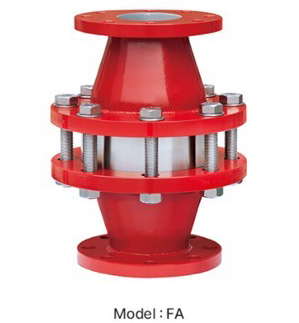
The flame arrester is designed to prevent flame transmission when flammable gas/air- or vapor/air-mixtures are presented. The model FA in-line flame arrester is designed, manufactured and tested according to API 2000 and EN 12874. Body material of arrester is available for nodular cast iron, cast steel, stainless steel grade 304, 316, 316L and special alloy steel for chemical resistance. The material of element is available for stainless steel grade 316L or special alloy steel for chemical resistance. The flame element is constructed with crimped ribbon metal.
Benefits
• Type Approved by IMO and ATEX ( European Directive 94/9/EC )
• Meet the latest international rule requirement of API 2000 and ISO 16852
• Protection against explosion and deflagration flame
• High flow capacity and minimum pressure loss
• Available bi-directional flow and flame passage
• Available vertical and horizontal installation
• Very easy maintenance for quick cleaning
• High performance chemical resistance material
Vapor Emission Control System
Introduction
• Minimizing the emissions of VOCS (Volatile Organic Compounds) from oil tankers during the fluctuating ambient conditions experienced during voyages is important from both environmental and commercial points of view.
• The controlled release is often undertaken when the gas pressure approaches a pre-set point. However, it is not always clear at what pressure a manually controlled release should be stopped. Without this information, excess vapor can be released, causing air pollution and a loss of gas.
• To meet this challenge, a VECS and Reporting System can be used to control the vapor pressure in oil cargo tanks to minimize and fully control VOC emissions. It is designed to comply with the latest international rules and regulations with an advanced reporting system.
• The VECS is installed on the mast riser’s bypass line, and controls the vapor pressure in all the cargo tanks during voyage for direct emission control in order to reduce VOC loss from the tanks during voyage.
• By controlling the pressure in the venting system, it is possible to fully control the VOC emissions.
• The VECS can be programmed to enable adjustment of the opening setting on the valve according optimal level for the specific cargo.
Benefits
• Remotely controlled opening/closing from C.C.R (Cargo Control Room)
• Setting value
o Opening pressure & Closing pressure : 1,500mmW.G ~ 1,700mmW.G (adjustable)
o Opening vacuum & Closing vacuum : -200mmW.G ~ -100mmW.G (adjustable)
• Adjustable of open/close pressure from C.C.R
o Opening setting and closing pressure are programmable
• Manual venting function
• Full open/close remotely by manual operation
• Operable from C.C.R (Cargo Control Room)
• The emission of V.O.C can be automatically controlled during the voyage.
• Emitted V.O.C flow rate can be recorded and printed.
• Explosion proof approved electric actuator (EX d IIB T4)
• Electric power source : AC 220V, 1Ph, 60Hz
• PLC unit for set adjustable and opening / closing pressure
• Signal : 4~20mA DC input.
• Hydraulic or electric actuator on request
• Local Hydraulic Power Unit (LPU)
Engine System
Explosion Relief Valve for Crankcase
Introduction
Safety is our top priority at PROSAVE
• PROSAVE’s quality assurance system complies with the latest ISO 9001 provision.
• PROSAVE explosion relief valves have received top mark in numerous explosion tests conducted by the FTZU institute and type approved by DNV, KR, LR, ABS, CCS, RS, BV, NK, RINA and MAN-ES.
Benefits
• Quick opening and fully releasing pressure.
• Responding and opening even at a very low pressure setting
• No flame escape to outside.
• Due to absolute tightness after opening and closing, it prevents from secondary explosion.
• Can be installed in all mounting position from vertical to horizontal type.
• Light weight and small volume for easy installation and maintenance.
• Free area of flame arrester is wide enough to similar relief area.
• Closing and sealing immediately after an explosion.
Explosion Relief Valve for Charge Air Chamber
Introduction
EVDM Series is mounted on the inlet manifold of the DF ENGINE or GAS ENGINE. If the explosion occurs during the movement of the gaseous fuel from the inlet manifold to the inside of the cylinder, explosion pressure can be discharged, and flame can be blocked and automatically distinguished by flame arrester element for prevention of the man and important facilities.
Benefits
• Automatic re-closing structures against rupture disc (non re-closing devices)
• No need of engine shut-down.
• Very high capability seat tightness.
• Available of continuous engine operation.
• Prevention of secondary explosion.
• Protection of man and key components due to explosion.
• Discharging protection of unfired and/or burned mist, gas, ashes and dust, into engine.
• Protection devices for Health, Safety and Environment.
• Available IoT options
Model : EVDE
There is little technical difference between EVDD and EVDE model.
But EVDE was tested according to the international standard IACS UR M82 was newly established in March 2023 and is applicable to engines or ships contracted from July 1, 2024.
It is a special one for applicable Ship’s Engine and was firstly tested and approved by this rule.
We are currently approved by DNV and KR classification societies, and ABS, BV, LR, etc. are waiting for classification review after application by the end of this year.
Also as IACS UR M82 4.3.5, the shield of this can be selected to option.
So EVDE was tested with 2 option with shield or without shield and also successfully passed the test.
Therefore, if the engine or vessel should be applied with IACS UR M82, we recommend you the select EVDE model.
Explosion Relief Valve for Exhaust Duct
Introduction
EVDD Series is mounted on the exhaust duct of DF ENGINE or GAS ENGINE. When an explosion occurs by unburned gas fuel in the exhaust lines, explosion pressure can be discharged by EVDD, and flame can be blocked and automatically distinguished by flame arrester element for prevention of the man and important facilities.
Benefits
• Automatic re-closing structures against rupture disc (non re-closing devices)
• No need of engine shut-down.
• Very high capability seat tightness.
• Available of continuous engine operation.
• Prevention of secondary explosion.
• Protection of man and key components due to explosion.
• Discharging protection of unfired and/or burned mist, gas, ashes and dust, into engine.
• Protection devices for Health, Safety and Environment.
• Available IoT options
Fire Fighting System / Ballast Water System
Vacuum Breaker
Introduction
KSVB, a spring-loaded model is designed to handle under pressure with a minimum pressure of -150mmW.C and maximum setting of -7,000mm W.C. Body material are available of Aluminum, Carbon Steel, 304SS, 316SS and Ni-Al Bronze with various trims to meet diverse customer requirements. Standard valve sizes range from 50mm and 300mm and can be varied according to customer request.
Benefits
• Designed manufactured and tested according to the API 2000 code.
• Utilized the latest technologies to provide protection against positive or vacuum over pressure and prevent air intake, evaporative losses of product and help to contain odorous and potentially explosive vapors.
Air Release Valve
Introduction
While the system is flowing under pressure, air release valves continually and automatically exhaust the small quantities of air that would otherwise be collected at system high points. This ensures the system remain free of trapped air (and sewage gases) thereby increasing system efficiency and reducing pumping costs.
Benefits
• Pressure relief function (exceeding atmospheric pressure)
• Liquid overflow protection
• Relief of small air pockets from pipeline
• Increase of pump efficiency
• Less system energy
• Maintenance free
Air Release & Vacuum Valve
Introduction
There is two critical time in the operation of a pipeline. During filling, air occupied in the empty pipe must be evacuated ahead of the incoming liquid in a controlled and efficient manner so that surge and water hammer can be minimized and liquid can completely be filled in the pipe. During draining, whether planned or unexpected, air must be admitted into the system to replace the out flowing liquid to avoid excessive vacuum and possible pipeline damage. Air release valve are designed to release accumulated air pockets from the system, while pipelines are pressurized. Air pockets cause increase of energy consumption because pumping operation will be at higher water heads to overcome pressured air. Air release valves have function to protect high shock and surge pressure, water hammer and liquid overflow from fresh or sea water pipelines. PROSAVE Valve can assure to provide low maintenance cost of pipelines and pump systems.
Benefits
• Pressure & Vacuum relief function
• Surge and water hammer prevention
• Liquid overflow protection
• Providing high capacity venting for pipeline protection
• Increase of pump efficiency
• Less system energy
• Maintenance free
Combination Air Valve
Introduction
Combination Air Valves are normally installed at high points of pipelines where air would naturally is arisen ahead of the incoming liquid during filling and collect air during operation and/or where negative pressure occurs during draining. The large (air release & vacuum breaker) and the small (air release) orifices are both opened during filling, and the majority of the air passes through the large orifice. The rate of air discharge is a function of the differential pressure across the air release & vacuum breaker valve. During filling, incoming water compresses the air in the empty pipe until the pressure differential across the air valve is sufficient, so that air is discharged at the same volumetric rate as water is entering the pipe.
After all the air has been purged, liquid enters the valve, lifts the float ball and closes both orifices. While the large orifice is closed, the small orifice is reopened as necessary to release any air that collected in the valve after it has closed. In case that the internal pressure falls below atmospheric pressure, both orifices are opened to allow air to flow through the valve into the system at the same volumetric rate at which the liquid is draining thus avoiding critical vacuum and damage to the pipe.
Benefits
• Pressure & Vacuum relief funciton
• Surge and water hammer prevention
• Liquid overflow protection
• Providing high capacity venting for pipeline protection
• Increase of pump efficiency
• Less system energy
• Maintenance free
• Release of small air pockets under operation pressure
Vacuum Breaker with Air Release Valve
Introduction
The VB-AR(L) model is a combination of KSVB and AR(L). When negative pressure occurs in the piping system, air flows into the valve from the outside by KSVB, and when the inside of the piping is filled, a small air pocket is discharged to the outside of the valve through AR(L).
Benefits
• Protection of piping systems from positive pressure or vacuum overpressure
• Avoid evaporative loss of product
• Discharge of small air pockets in piping system
Foot Valve Introduction
Foot valve is virtual secondary suction valve placed at the bottom or foot of the suction pipe.
Foot valve has function of check valve that make sure that the pump is always primed.
θα επικοινωνήσουμε άμεσα μαζί σας για να σας λύσουμε όλες της απορίες.
Είμαστε έτοιμοι να απαντήσουμε τώρα!
Εγγραφείτε και θα επικοινωνήσουμε ΑΜΕΣΑ!
Error: Contact form not found.
Συναινώ στην επεξεργασία προσωπικών δεδομένων και συμφωνώ με τη συμφωνία χρήστη και την πολιτική απορρήτου
Είμαστε έτοιμοι να απαντήσουμε τώρα!
Εγγραφείτε και θα επικοινωνήσουμε ΑΜΕΣΑ!
Error: Contact form not found.
Συναινώ στην επεξεργασία προσωπικών δεδομένων και συμφωνώ με τη συμφωνία χρήστη και την πολιτική απορρήτου